


Portable X-Ray Units and the PX Handheld X-Ray Camera
VEOX Portable is a family of compact X-ray units for imaging outside the radiography room. PX 3.5K, PX 5.6K and PX 8K cover portable radiography at three output levels, and the PX Camera is a handheld X-ray camera weighing approximately 1.4 kg, operating at 40 to 70 kV with a 0.4 mm focal spot, for the most mobile field and bedside work.
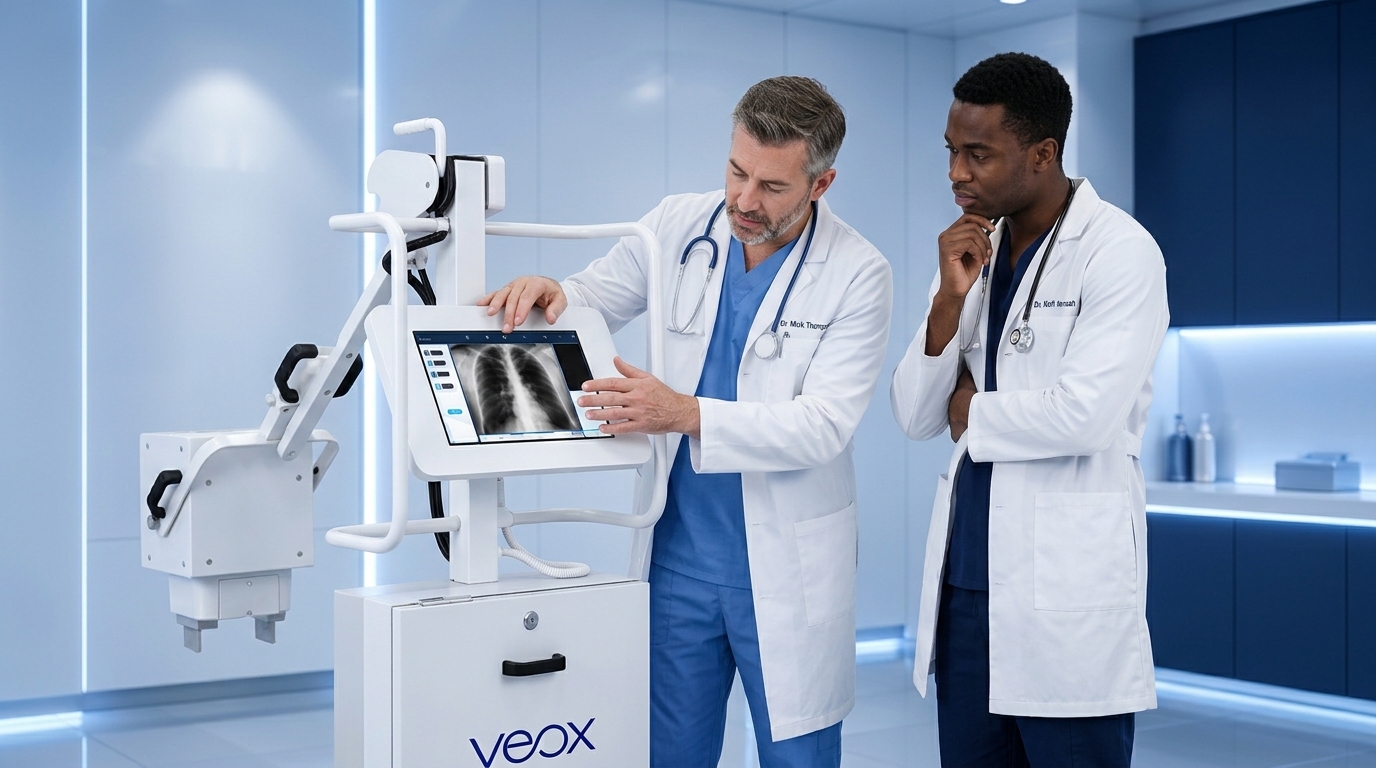
What Is the VEOX Portable PX Series?
The VEOX Portable PX Series is a family of compact and handheld X-ray units for imaging where a mobile or fixed system cannot practically go. It covers three portable configurations, PX 3.5K, PX 5.6K and PX 8K, corresponding to their maximum outputs, plus the PX Camera, a handheld X-ray camera positioned as the most mobile solution in the VEOX portfolio.
Portable radiography is defined by constraint. There may be no radiography room, no reliable mains supply, no assistant and no time. The PX Series is configured for that: an optional battery configuration removes dependence on site power, wired and wireless exposure control lets the operator step away from the tube, and a touchscreen APR interface keeps technique selection quick for staff who are not standing in a control booth.
A folding or mobile trolley is offered as an option across the portable configurations. As with the rest of the VEOX range, the trolley is an accessory decision and never a change of model name.
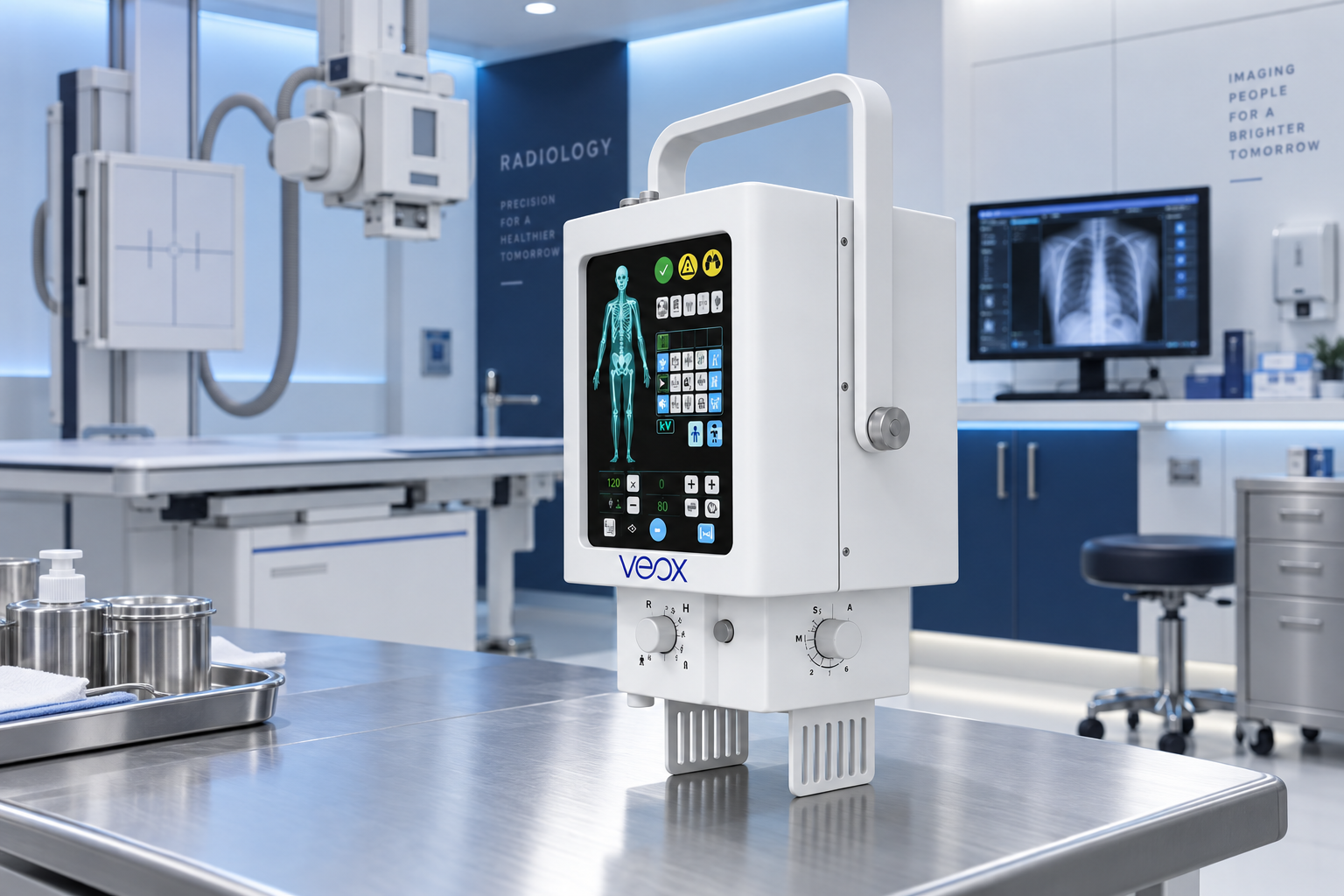
An X-Ray Camera You Carry Rather Than Push
The PX Camera is a distinct model inside the Portable family: a handheld X-ray camera weighing approximately 1.4 kg, operating between 40 and 70 kV at 1 to 3 mA with a 0.4 mm focal spot and USB communication. It is designed to be carried to the point of care and operated by one person.
That form factor opens up work that a wheeled unit cannot reach. Outreach programmes, remote and rural clinics, mobile screening, care settings without an imaging room, and field response all sit inside its practical range, with a compatible flat panel detector completing the digital chain.
- ›Approximately 1.4 kg handheld design, carried rather than wheeled
- ›40 to 70 kV, 1 to 3 mA, 0.4 mm focal spot, USB communication
- ›Operated by a single user at the point of care
Built for Imaging Away From the Radiography Room
The PX Series is specified around the practical constraints of portable work: power, exposure control and transport.
Optional Battery Configuration
A battery configuration is available across the portable models, removing dependence on the electrical supply at the location. This is the difference between a unit that works in a rural clinic or a mobile screening vehicle and one that is limited to buildings with dependable mains.
Wired and Wireless Exposure Control
Exposure can be triggered by wired or wireless control, and technique selection runs through a touchscreen APR interface. In a room without a shielded control booth, wireless exposure control is a radiation protection decision as much as a convenience.
Folding Trolley and Digital Chain
A folding or mobile trolley is an option, not a model variant. Digital acquisition runs with a detector from the VEOX View VX range into VEOX Workstation WX for review and PACS routing.
VEOX Portable PX Series Models Compared
The PX Series covers three portable output levels plus the handheld PX Camera. Selection depends on the projections required, how far the unit travels and whether an operator carries it or wheels it.
| Model | Output Positioning | Typical Use | Transport |
|---|---|---|---|
| PX 3.5K | Entry portable configuration | Clinics, outreach visits, extremity and light general work | Carry case or optional trolley |
| PX 5.6K | Mid portable configuration | Mobile screening, care settings, broader routine projections | Carry case or optional trolley |
| PX 8K | Highest portable output in the series | Demanding portable radiography and denser projections | Carry case or optional trolley |
| PX Camera | Handheld X-ray camera, approximately 1.4 kg | Point of care, field response, remote and constrained settings | Handheld, single operator |
Full power, battery, exposure, dimensions, detector, workstation and camera specifications are provided in the PX technical catalogue during the specification stage.
PX Series Configuration at a Glance
The table summarises how a VEOX Portable unit is normally specified. Battery, exposure control, trolley and detector choices are set against where the unit will actually be used.
Portable work introduces variables a fixed room never faces: transport method, available power, shielding conditions and who is operating the unit. Those are reviewed before a configuration is quoted so the delivered system is usable in the field rather than only on paper.
Discuss your portable imaging requirements| System type | Portable and handheld X-ray units |
|---|---|
| Models | PX 3.5K, PX 5.6K, PX 8K, PX Camera |
| Battery | Optional battery configuration, source supported |
| Exposure control | Wired and wireless exposure control |
| Interface | Touchscreen with APR |
| Trolley | Folding or mobile trolley option, no model suffix |
| PX Camera weight | Approximately 1.4 kg |
| PX Camera output | 40 to 70 kV, 1 to 3 mA |
| PX Camera focal spot | 0.4 mm |
| PX Camera communication | USB |
| Detector | Flat panel detector from the VEOX View VX range |
| Software | VEOX Workstation WX, DICOM 3.0 and PACS workflow |
Where the PX Series Fits
VEOX Portable is specified for imaging that happens away from a permanent radiography installation.
Outreach and Mobile Screening
Community screening programmes, mobile clinics and campaigns where the imaging capability has to arrive with the team.
Remote and Rural Clinics
Facilities without a dedicated radiography room or a dependable mains supply, where a battery configuration decides feasibility.
Point of Care and Bedside
Care settings, long-stay facilities and constrained bed spaces where a wheeled unit cannot reach the patient.
Field and Emergency Response
Deployed and temporary settings where equipment is carried in and set up quickly by a small team.
Supply, Installation and Support
VEOX supplies medical imaging systems to hospitals, diagnostic imaging centres, distributors and healthcare projects internationally, with active coverage across the Middle East, North Africa, the GCC and wider African markets. Requirements differ by market, from tender documentation and regulatory paperwork to electrical supply conditions and service reach, so each enquiry is scoped against the conditions at the installation site rather than a single regional template.
Project Specification
System configuration, detector format and output are matched to the facility, the case mix and the room before quotation.
Commissioning and Training
Installation planning, commissioning and radiographer familiarisation are agreed inside the project scope, not left to delivery day.
Tender and Distributor Support
Technical documentation, catalogues and configuration sheets are supplied for tender submissions and distributor enquiries.
Frequently Asked Questions About VEOX Portable
What is a portable X-ray machine?
+
A portable X-ray machine is a compact X-ray unit that can be transported in a case or on a light trolley and set up wherever imaging is needed, rather than being installed in a room or wheeled through a hospital. It typically offers a battery option, a touchscreen control interface and wired or wireless exposure control. The VEOX Portable PX Series covers PX 3.5K, PX 5.6K, PX 8K and the handheld PX Camera.
What is the difference between a portable X-ray unit and a mobile X-ray unit?
+
A mobile unit, such as the VEOX Move MX Series, is a wheeled system designed to travel inside a hospital to wards, intensive care and emergency departments. A portable unit, such as the VEOX Portable PX Series, is a lighter system that can be carried and set up away from the hospital entirely, in clinics, outreach programmes, remote settings and field work. Mobile is about moving through a building, portable is about leaving one.
What is an X-ray camera?
+
An X-ray camera is a handheld X-ray source small and light enough to be held and operated by a single user at the point of care. The VEOX PX Camera weighs approximately 1.4 kg, operates at 40 to 70 kV and 1 to 3 mA with a 0.4 mm focal spot, and uses USB communication. It sits inside the VEOX Portable family as its most mobile model.
Can the PX Series run on battery power?
+
An optional battery configuration is supported across the portable models. Battery operation removes dependence on the electrical supply at the location, which is often the deciding factor for outreach programmes, mobile screening vehicles and clinics in areas with unreliable mains power.
Is exposure control wireless?
+
Both wired and wireless exposure control are supported, with technique selection through a touchscreen APR interface. Wireless exposure control lets the operator maintain distance from the tube in settings where there is no shielded control booth, which is a radiation protection consideration as much as an operational one.
Which detector works with the PX Series?
+
Digital acquisition uses a flat panel detector from the VEOX View VX range, with a wireless panel being the usual choice for portable work. Images are acquired, reviewed and routed to PACS through VEOX Workstation WX. Detector format is confirmed against the intended examinations during specification.
Complete the Digital Imaging Workflow
VEOX Move, MX
Mobile digital radiography for ICU, emergency and ward imaging inside the hospital.
Explore VEOX Move ›VEOX View, VX
Wireless and wired flat panel detectors for portable acquisition.
Explore VEOX View ›VEOX Workstation, WX
Acquisition, viewing and PACS routing software for portable systems.
Explore VEOX Workstation ›Need Imaging Where There Is No Radiography Room?
Tell us where the unit will be used, whether battery operation is required and what examinations you need to cover. We will come back with the appropriate VEOX Portable configuration.